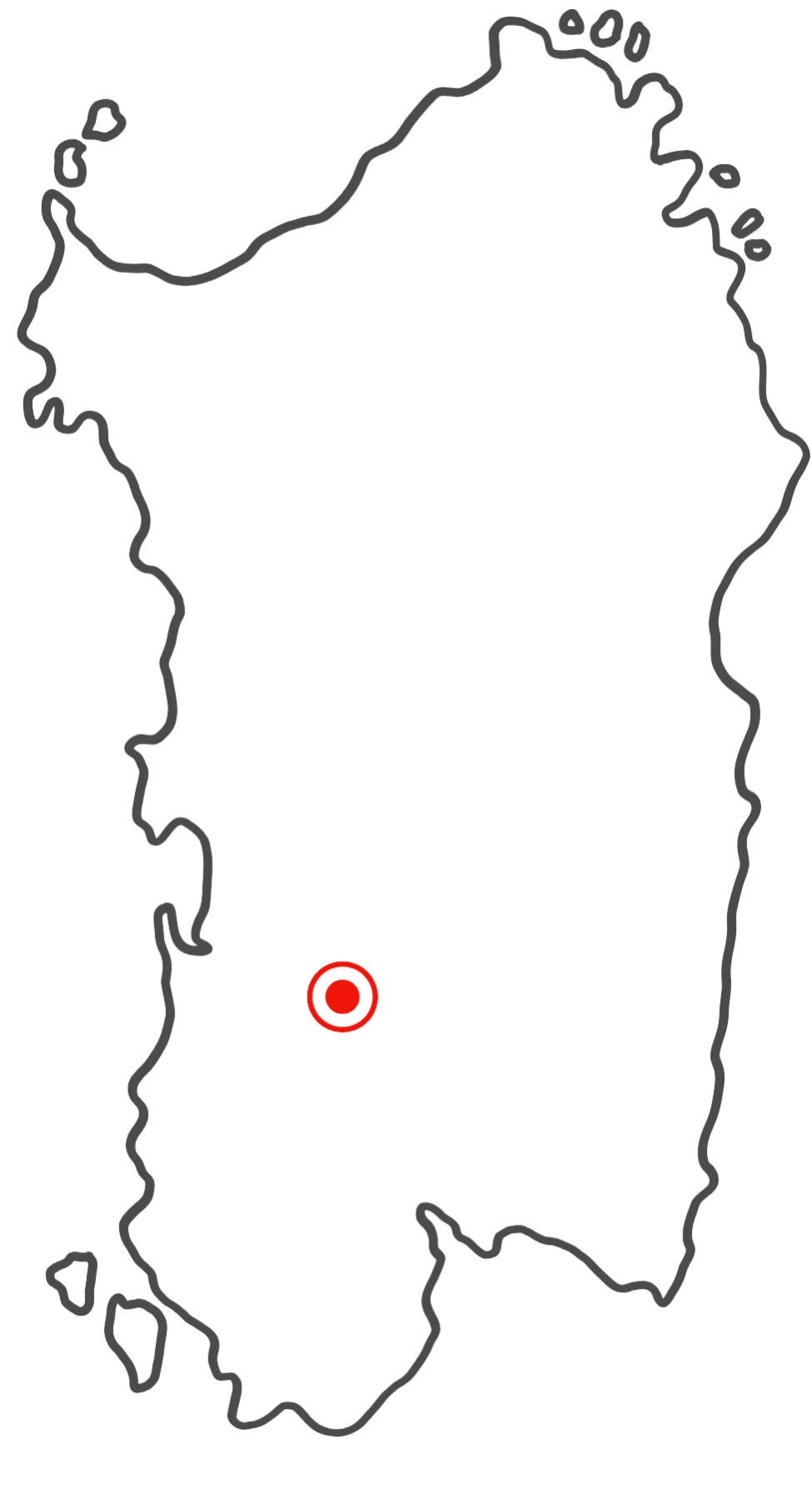
Let Sardenya introduce you to a place that certainly doesn’t need any lesson on how to stand out.
The only thermal town in the Campidano di Sanluri.
One of the very few villages in all of Sardinia whose historic center houses an archaeological area.
In one word: Sardara.
After all, there’s always a very good reason why the Touring Club Italiano awards a town one of its Orange Flags, and here in Sardara, there are dozens of reasons to proudly wave this prestigious banner.
At the top of the list of wonders are the Aquae Neapolitanae, the name the ancient Romans gave to the springs of Santa Maria Acquas (just 4 km from the town center), where in 200 B.C. they built what was essentially a votive thermal temple.
And if the underground waters of the Sardara countryside reach temperatures between 50 and 68 °C, it’s the Pozzo Sacro of Sant’Anastasia, locally known as Sa Funtana de Is Dolus (“the Fountain of Sorrows”), that warms and welcomes visitors in the town itself.
This Nuragic place of worship, nestled in a medieval-feeling historic center, is surrounded by a sacred area including several huts and the Church of Sant’Anastasia, built atop the remains of a Byzantine building, which houses a second, smaller sacred well.
The rest of the village is best enjoyed step by step, wandering through stone-paved alleys and charming corners, discovering historic buildings such as Villa Abbas (home to the Archaeological Museum), Casa Pilloni, and Villa Diana, all part of Sardinia’s itinerary of Prestigious Villas and Residences.
And as the cherry on top of an already rich and enticing “cake,” just a few kilometers south of the town, atop a hill 280 meters above sea level, stands the Medieval Castle of Monreale. A significant and imposing fortified structure now reduced to ruins, but at its peak it included a village enclosed by eight towers, spanning a total area of 4.6 hectares.
A charming and intriguing attraction that offers fascinating traces of its past, along with breathtaking views of the Campidano plain and the Marmilla hills.