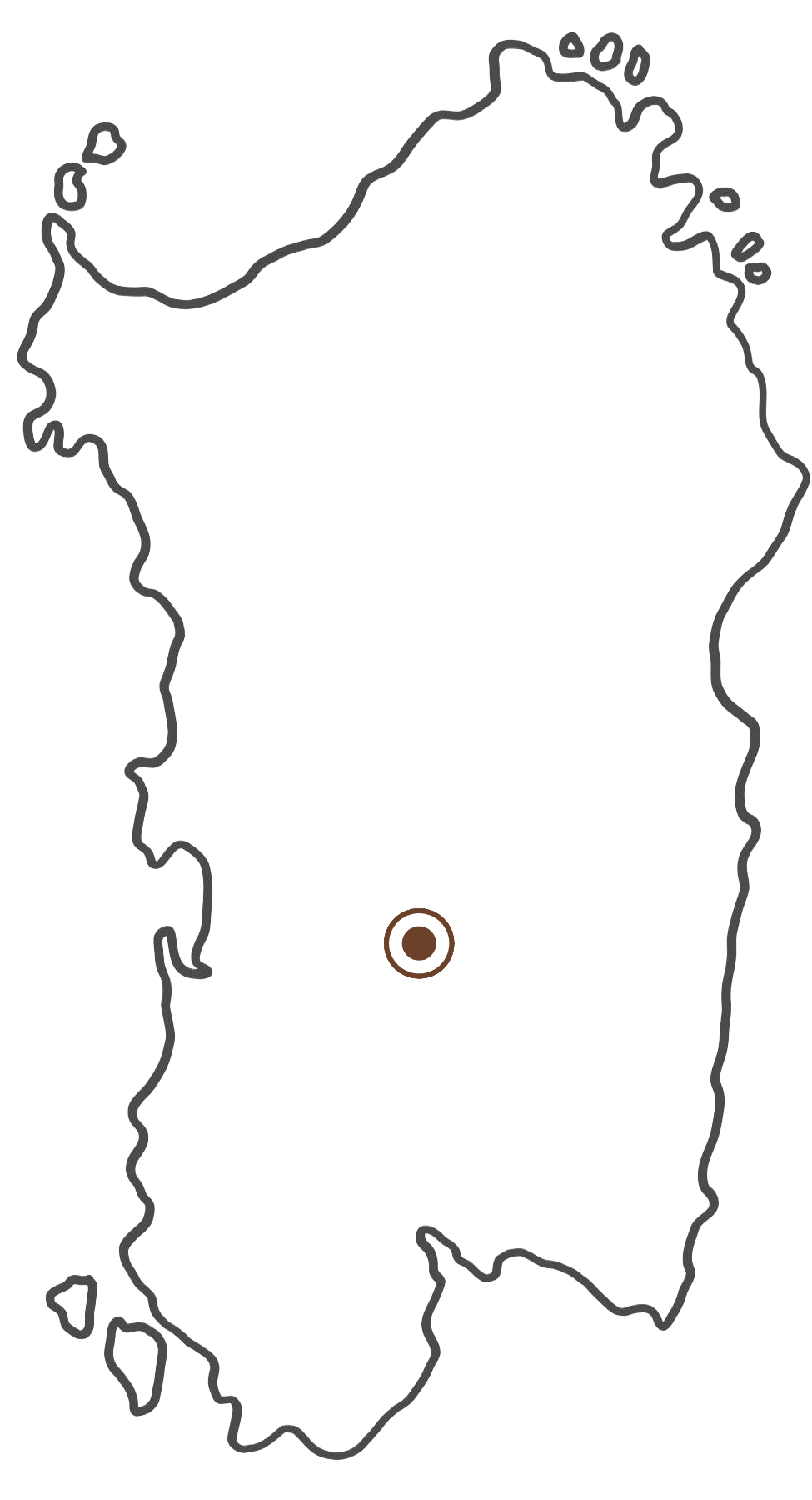
Amid the gentle hills of the Marmilla, where wheat fields sway like a golden sea and the wind carries the scent of freshly turned earth, rises a solitary hill. It is a miniature mountain, perfectly conical, and crowning its summit—like a diadem faded by time—stand the ruins of the Castle of Las Plassas, once a stronghold of the Judges of Arborea and later an Aragonese bastion.
Today, only its jagged white walls remain, carved by sun and rain, yet it is precisely this bare, silent ruin that tells its story better than any written chronicle. The marlstone with which it was built captures the light in a unique way: at dawn it gleams like ivory, at sunset it blushes with pink, and by night it becomes a silver blade etched against the starry sky.
Once, this place echoed with the shouts of soldiers, the pounding of hooves, the clash of steel. Now only the whistle of the wind remains, slipping through the stones like an ancient storyteller. And yet, climbing up to the fortress, one need only close their eyes to see the banners of Arborea fluttering in the sun, the sentinels scanning the horizon, the torches burning along the walls.
From up there, the view commands the whole Marmilla: a boundless panorama of cultivated fields, vineyards, and basalt plateaus, dotted with nuraghi and solitary chapels. To the north rises the imposing Giara of Gesturi; to the south, the Campidano stretches toward the sea. Everything appears small, almost fleeting, while the castle—reduced though it is to a handful of stones—still stands with the dignity of one who has never ceased to watch over the land.
The Castle of Las Plassas is more than a monument: it is a presence suspended between history and legend, a luminous scar upon the landscape, a stone beacon reminding us how fragile time is, and how stubborn memory can be.