


The Colorful Universe of Sardinian Traditional Costume
A mosaic of fabrics, gold, and ancient symbols. Discovering the textile art that transforms tradition into a living masterpiece.
Every fold, every embroidery, and every nuance of color in a Sardinian traditional costume is never a matter of chance, but a silent language that tells stories of family, social status, and millenary traditions. Far beyond its aesthetic value, traditional attire represents the profound identity of every community on the island, transforming each individual garment into a work of art jealously guarded over time.
In this in-depth exploration, we will discover the symbolic meaning and artisanal mastery that make the Sardinian costume one of the most vibrant and fascinating elements of the Mediterranean cultural heritage.
Did You Know?
The extraordinary textile heritage of Sardinia branches out into about 400 different and unique styles. Each traditional garment encapsulates the deep and fascinating history of this land, shaped over the centuries by Roman, Eastern, and Spanish-Aragonese influences.
The Origin and Extraordinary Variety
The immense sartorial heritage of Sardinia represents a unique cultural phenomenon in the Mediterranean landscape, characterized by more than 400 different costumes that vary significantly not only from one province to another, but even among neighboring towns.
This incredible stylistic multiplicity reflects a millenary and complex history, shaped over the centuries by deep interactions with Roman, Eastern, and Spanish-Aragonese civilizations that traversed the island.
Each community has been able to rework these influences through its own identity filter, codifying into the details of the clothing a true visual language that clearly distinguished territorial belonging, family roots, and the cultural specificities of each individual local population.


Materials, Weaving, and Technique
The art of artisanal textile processing constitutes one of the fundamental pillars of Sardinian tradition, faithfully handed down from generation to generation through the skillful use of the vertical or horizontal loom. Local weavers predominantly employed top-quality natural fibers, starting with wool sheared from local sheep, moving on to durable linen, and culminating in the highly precious sea silk (bisso), a golden fiber extracted from bivalve mollusks.
Every gesture made during crafting responded to ancient and rigorous rules, capable of bringing exceptionally dense, warm, and durable fabrics to life. The complexity of the embroidery and the geometric precision of the bodices testify to a superlative technical mastery, in which the raw material was transformed into an authentic masterpiece of textile art.
Social Symbolism and Tradition
The traditional Sardinian attire did not exhaust its function in mere aesthetics or protection from atmospheric agents, but represented a true code of non-verbal communication within the community. Through the style, cuts, and ornaments, it was possible to immediately identify the social status, economic well-being, and class of the wearer. Of particular importance was the distinction linked to marital status, where unmarried women, brides, and married or widowed women displayed sartorial details codified by secular customs.
This profound bond transformed every dress into a living document of collective history, capable of transmitting the values of belonging and the social cohesion of an entire island population across the ages.


Colors, Dyeing, and Geometries
The chromatic palette and decoration of traditional Sardinian fabrics are rooted in a profound botanical and empirical knowledge, based on the extraction of natural pigments from local plants, roots, and lichens. These plant substances made it possible to obtain intense and long-lasting hues, from dark red to saffron yellow, capable of withstanding time and wear. The weaves were enriched by a repertoire of geometric, anthropomorphic, and zoomorphic motifs of extraordinary charm, imbued with ancient symbolic and protective meanings against adversity.
Every decoration was never random but responded to rigorous aesthetic canons, transforming the fabric into a speaking surface where magic and popular devotion blended harmoniously.
The Jewels
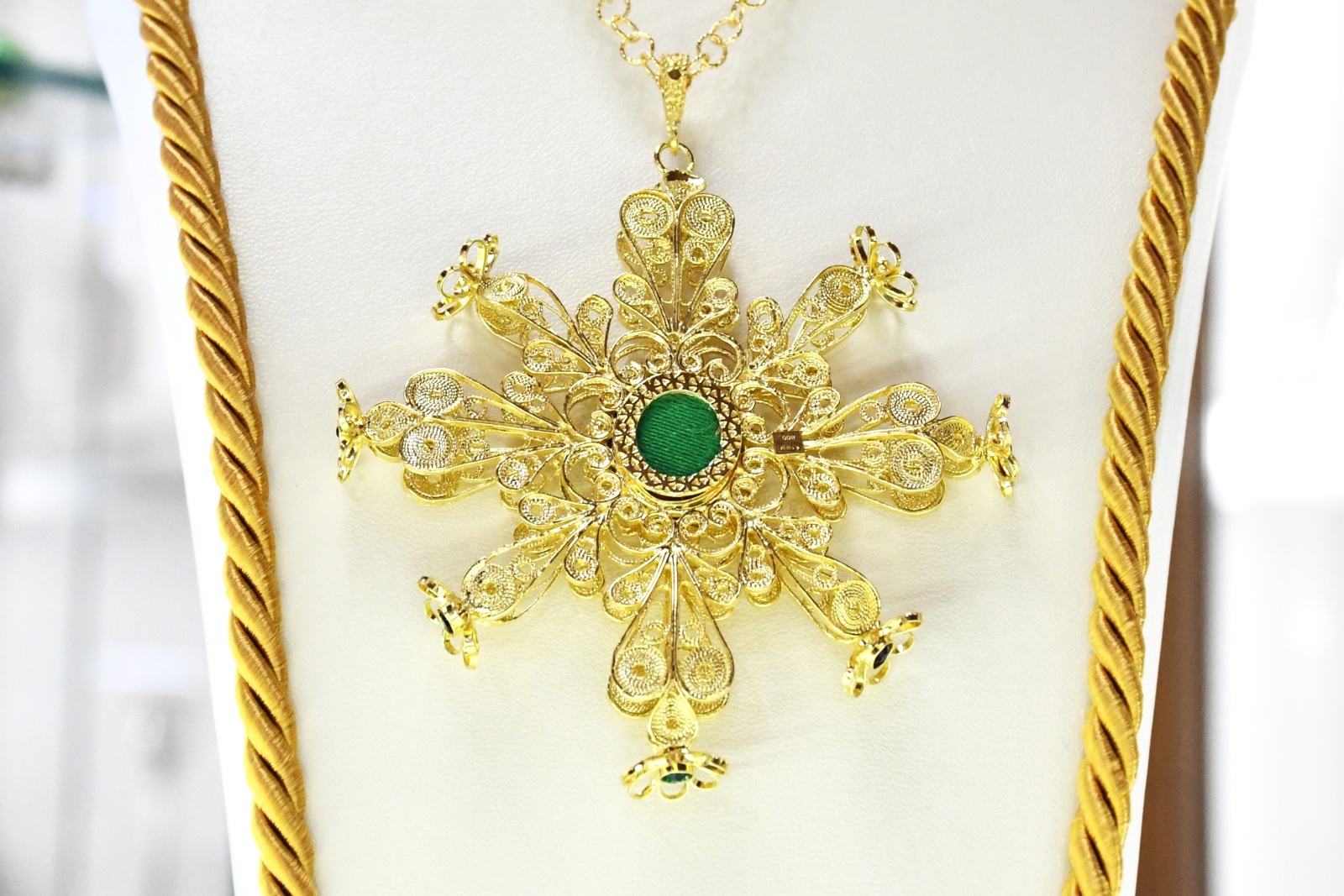
The ornamental apparatus of traditional Sardinian costumes found its highest expression in gold and silver filigree jewelry, true masterpieces of local goldsmithing. Among these stood out the Sardinian Wedding Ring (Fede Sarda or anellu de pattu), a solemn symbol of a bond and promise of love, flanked by characteristic buttons called su buttoni, whose spherical shape recalled fertility and abundance. Also of great fascination were the pieces of jewelry called Corbula, crafted using the extremely fine technique of granulation and metal braiding.
Every single piece did not serve a mere decorative function but embodied deep protective, religious, and identity meanings, jealously handed down from mother to daughter as priceless family treasures.

Conservation and Memory
The contemporary value of this extraordinary textile heritage finds its highest expression in the great parades and identity festivals of the island, moments in which traditional attire comes back to life and parades with pride. Much more than a simple museum artifact to be jealously guarded, it represents a living and pulsing tradition that continues to thrill new generations.
Thanks to the dedication of master artisans and local associations who preserve the secrets of ancient tailoring construction, island culture continually renews its bond with the past. This tenacious conservation work ensures that the historical memory and the most authentic soul of Sardinia continue to shine intact into the future.
But the story doesn't end here...
This extraordinary sartorial heritage does not end in museum display cases or solemn festive parades, but continues to find vital nourishment in the daily commitment of young stylists and contemporary designers. Many local artisan workshops today choose to interpret geometric motifs, traditional fabrics, and historical cuts, blending them with modern fashion trends. This successful cross-pollination makes it possible to bring Sardinian fabrics onto international runways and into everyday life, demonstrating extraordinary creative vitality. The island's material culture thus transforms into a dynamic bridge between past and future, capable of continuously renewing itself without ever betraying its most authentic roots.


Would you like to plan an itinerary?
Let us know which places you would like to visit, and we will build a tailor-made itinerary just for you.